
Today I'm going to teach you how to write reflections for multiple reasons which I'll list out below:
-I got an assignment on reflective writing-It's the most easiest solid thing I learned that I can share with you guys
-2016 is coming to an end and what better time than this to learn reflective writing?
What is reflective writing though? Reflective writing works on this model:
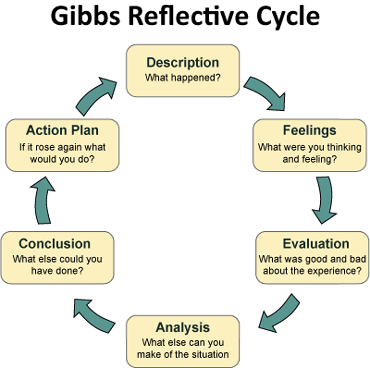
Fair enough, right? You work in that order to think about a problem you've had. That's it. That's reflective writing. That's all you gotta know. You start writing or thinking. It helps to make this a regular habit since you'll be able to seriously learn from your experiences.
Here's what I wrote. Not only will it give you an idea about reflective writing, but it'll also let you know about how my week had been going.
Earlier this week, I found out that my history notebook had been misplaced. This history notebook was very important because it needed to be submitted at the end of the gynecology rotation. I had given it to one of my receptors to get checked and it had gone missing in the process.
When I first found out about my notebook going missing, I was not alarmed since I had been told that I would get my grades put in without the history notebook. When I found out that the entire portfolio needed to be submitted, I became worried and decided to check in with the clinical administration. They told me that I would need to rewrite the entire notebook in order for it to be submitted and my grades to be calculated, which made me feel like the entire procedure was very unfair for me. My friend and I forwarded the incident to a few other preceptors, which made me feel apprehensive. I received a call just this weekend explaining that my notebook had been found, which made me feel very relieved. The incident came to a close with some received feedback.
The good thing about this incident was that it made me get out of my comfort zone to talk to people in order to get my work done. It also showed me all the ways that you could approach an issue, such as talking in person, sending an email or discussing with the correct authorities. I also learned that it's important to cover all of your bases right from the start and that if something seems fishy, it's important to hammer out the details, as well as the fact that there is a hierarchy that needs to approached in a correct way if you want your concerns to be addressed.
The bad thing about this incident included the fact that I ended up getting quite stressed over it and was finding it difficult to focus on my studies. I also kept imagining the worst outcomes and was mentally preparing for them. At one point I had even given up and decided to start working on a new history notebook quietly. I also found myself more easily irritable and on edge.
Thinking over this incident, I have decided to focus on all the things that went right. I feel that it was the right thing to do when I decided to approach the administration to question on how the mishap could be dealt with. It was also the right thing to email the correct authorities to update them on what had happened and ask for their help. These actions should have been done right from the start if there had been continuous communication though.
Concluding this incident, I realized that there were ways in which the situation could have been handled better. First of all, this entire situation could have been avoided if we had decided to value giving things directly, instead of giving things on time. My friend and I had been focusing on trying to get our work done on the time we had promised to turn it in and this had resulted in a mishap with stress and a whole week lost. Secondly, we should have gone to get our history notebooks checked up by the person they were supposed to go to. That way, we would have found out about the mishap much earlier and been able to do something about it. Thirdly, we had ended up thinking about making a new notebook entirely, instead of looking for the lost notebook. Assuming that notebooks would get lost in a hospital that runs on patient files that look absolutely identical was not the right course of action.
If this sort of incident was to happen to me again, I would definitely react in a different. My first plan of action would be to find whatever is missing. Most of the time, such things have only been misplaced and people dismiss the value of the lost item by just saying "get another one". I should also improve my communication skills. I found myself stuttering half the time when I needed to speak out about what my problem was. Maybe I didn't appear to have any communication issues to a third person, or even the second person I was talking to, but I certainly felt some fluency was lost under the pressure of the situation. I should practice my verbal skills more in order to be able to convey my grievances properly next time. Apart from that, I also need to pay more attention to orienting myself in regards to the hierarchy of authorities to approach for a problem, instead of approaching whoever I find most accessible. It's important to work within the system in order to minimize more problem arising from the primary concern.Have you ever thought reflectively about things that have happened in your life? This whole exercise would especially be interesting for people who keep daily journals, although if you don't keep a journal, this could definitely be a good prompt if you would like to get started! Have a nice day!

